
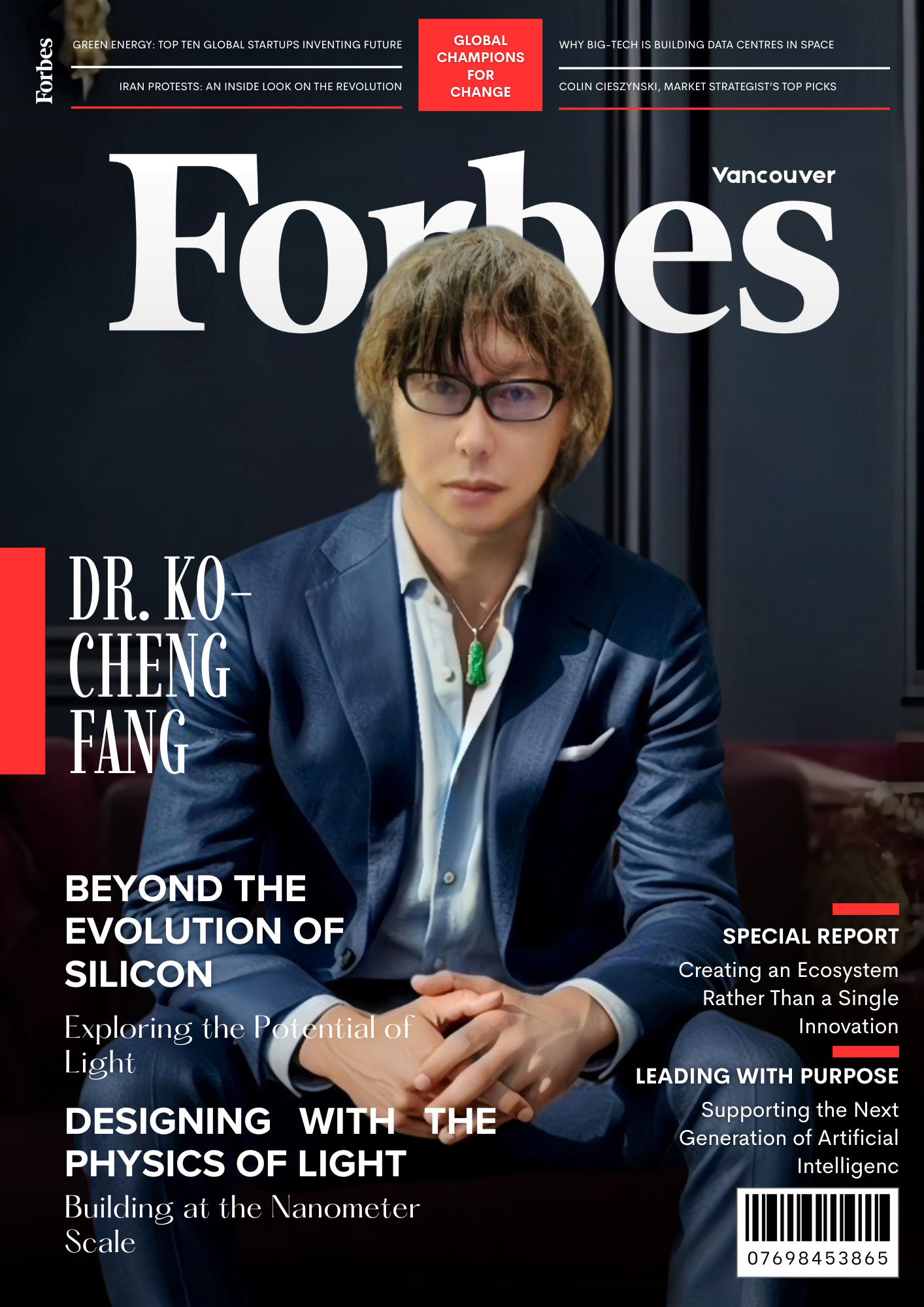
From Silicon to Photons: Dr. Ko-Cheng Fang’s Ambition to Shape the Future of Intelligent Computing
Artificial intelligence is no longer a glimpse into the future—it has become an essential part of the present. It is changing how businesses make decisions, how hospitals diagnose illnesses, how engineers design products, and how scientists accelerate research. As AI grows more sophisticated, it is reshaping industries at a pace few could have predicted.
Yet behind every remarkable AI achievement lies an often-overlooked challenge: the hardware responsible for making it possible.
Today’s computing infrastructure was built for an era when processing requirements were measured very differently. Modern AI systems now perform trillions of calculations, analyze enormous datasets, and require unprecedented levels of computational performance. As these demands continue to rise, many researchers believe the future of AI will depend not only on better algorithms but also on a new generation of computing technologies.
Among the innovators exploring that future is Dr. Ko-Cheng Fang, Founder, CEO, and Chairman of LongServing Technology Co., Ltd., whose research is focused on photonic computing—a field that replaces conventional electrical data transmission with the movement of light.
Dr. Ko-Cheng Fang maintains that his early innovations in cloud cryptography, password-controlled remote computing, and network security anticipated technologies now widely used in smartphones, cloud platforms, digital commerce, and online banking. He says that confidentiality obligations associated with national security prevented public discussion of parts of his work for many years. Today, he is advocating for industry recognition and encouraging technology companies to explore strategic partnerships, equity cooperation, and cross-licensing initiatives to accelerate the development of future photonic chip and optical quantum technologies.
Beyond the Evolution of Silicon
For more than five decades, silicon semiconductors have served as the foundation of modern computing.
Each new generation of processors has delivered greater speed, increased efficiency, and higher transistor density. Those improvements have enabled everything from smartphones and cloud computing to autonomous systems and artificial intelligence.
However, every technological platform eventually approaches practical limits.
As transistor dimensions continue shrinking, engineers encounter increasing challenges related to heat dissipation, electrical resistance, power consumption, and manufacturing precision.
According to LongServing Technology, future computing may require a new architecture rather than simply a more advanced electronic chip.
Exploring the Potential of Light
Unlike conventional processors that rely on electrical current, photonic computing uses photons to transport information.
Light offers characteristics that have attracted scientific interest for decades. Photons travel rapidly and generate far less heat than electrons, making them attractive candidates for future high-performance computing systems.
The difficulty has always been one of engineering rather than theory.
Creating microscopic structures capable of directing light with sufficient precision has remained one of the field’s greatest technical challenges.
LongServing Technology believes its proprietary X-Photon material represents meaningful progress toward solving this problem.
Engineering Optical Pathways

According to the company, X-Photon has been developed specifically for optical information transmission.
Instead of functioning like a traditional semiconductor conductor, the material forms microscopic optical channels through which photons can travel while remaining confined within the circuit.
Recently, LongServing Technology demonstrated one of the material’s key capabilities.
During laboratory testing, laser light successfully entered an optical pathway before completing a controlled 90-degree directional turn.
Although the movement appears straightforward, it represents an important engineering achievement.
Future optical processors require light to travel through highly complex circuit layouts while continuously changing direction between computational units and memory systems.
According to the company, X-Photon enables that level of controlled optical guidance.
Designing with the Physics of Light
Dr. Fang explains the concept using a familiar observation from everyday life.
A mirror redirects light because its reflective surface changes the beam’s direction without interrupting its movement.
Similarly, LongServing Technology states that X-Photon incorporates specially engineered reflective structures that guide photons through microscopic optical channels.
Instead of allowing light to scatter away from the circuit, these optical pathways continually redirect photons toward their intended destination.
According to the company, this design philosophy creates the foundation for future photonic processors capable of handling increasingly sophisticated computational tasks.
Building at the Nanometer Scale
Miniaturization remains one of the defining challenges of advanced computing.
Optical technologies must operate at dimensions compatible with modern semiconductor fabrication if they are to become practical.
LongServing Technology reports that X-Photon operates with wavelengths averaging approximately 2 to 3 nanometers, enabling extremely compact optical structures.
The company also states that it has successfully fabricated 10-nanometer optical circuits, supporting ongoing development of photonic processors, optical memory systems, and integrated photonic computing architectures.
According to LongServing Technology, reducing optical structures to nanometer dimensions represents an important milestone toward practical implementation.
Creating an Ecosystem Rather Than a Single Innovation
While many organizations focus on developing individual processors, LongServing Technology’s strategy extends much further.
Dr. Fang envisions a complete ecosystem built around photonic technologies.
The company’s development roadmap includes 2nm Multi-Bit Optical Quantum Chips, integrated photonic memory, advanced optical communication pathways, and Photonic Cloud Computing Centers designed specifically for artificial intelligence.
Rather than existing as separate technologies, these components are intended to work together as a unified platform capable of supporting future AI infrastructure.
According to the company, this integrated approach could improve computational efficiency while addressing the increasing demands placed on modern computing systems.
Supporting the Next Generation of Artificial Intelligence
Artificial intelligence continues expanding into virtually every sector of the global economy.
Healthcare providers rely on AI for diagnostics.
Financial institutions analyze complex market data using machine learning.
Manufacturers optimize production through intelligent automation.
Scientists employ AI to accelerate discoveries across medicine, chemistry, and materials science.
Each advancement increases demand for more capable computing infrastructure.
LongServing Technology believes photonic computing represents one possible pathway toward meeting those future requirements.
Because photons generate considerably less heat than moving electrons, optical architectures could potentially improve processing efficiency while reducing cooling and energy requirements.
According to the company, these advantages make photonic computing an important area of continued research.
Turning Innovation into Industrial Progress
Scientific research is only one part of technological advancement.
Commercial development, manufacturing capability, and strategic partnerships are equally essential.
To support its long-term objectives, LongServing Technology recently announced a $500 million strategic financing initiative, based on a stated $2.5 billion corporate valuation.
According to the company, the investment will support expanded research, photonic fabrication facilities, manufacturing capabilities, and future cloud computing infrastructure.
The company has also introduced a Strategic Equity Hedging Protocol, intended to encourage strategic partnerships with organizations interested in participating in the commercialization of photonic technologies.
Dr. Fang believes collaboration across research institutions, manufacturers, investors, and industry leaders will help accelerate the development of future computing platforms.
Looking Ahead

Every technological revolution begins with individuals willing to challenge conventional thinking.
Today’s digital world was built on semiconductor innovation.
Tomorrow’s intelligent world may require an entirely new foundation.
While photonic computing remains an evolving field, LongServing Technology continues advancing research that explores how light could transform the way information is processed.
Through developments involving X-Photon, nanoscale optical routing, photonic memory, and integrated optical computing infrastructure, the company is contributing to the growing global effort to redefine high-performance computing.
For Dr. Ko-Cheng Fang, the goal is not simply to improve today’s processors.
It is to help build the technological framework for a future where artificial intelligence is powered by a computing architecture designed around one of nature’s most remarkable resources—the speed and precision of light.
Contact Information
Dr. Ko-Cheng Fang
Founder, CEO & Chairman
LongServing Technology Co., Ltd.
Email: service@longserving.com.tw
Website: https://longserving.com.tw/en/
Instagram: @ko_cheng_fang