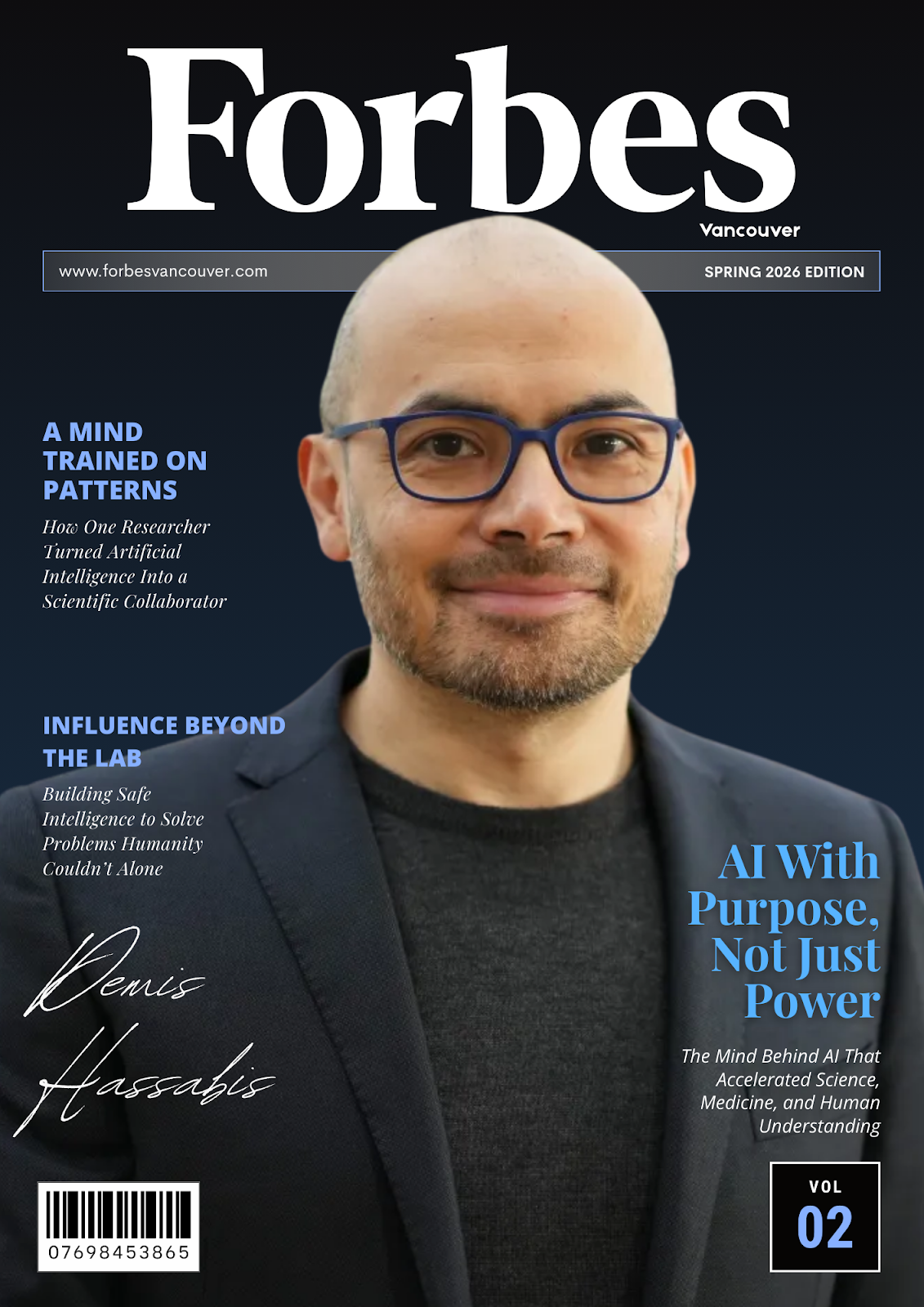
Engineering Intelligence: How Demis Hassabis Is Rewriting the Rules of Scientific Discovery
A Mind Trained on Patterns
Long before artificial intelligence became a global obsession, Demis Hassabis was learning how complex systems think. As a child chess prodigy, he mastered strategy and foresight before most people encounter either. Later, as a neuroscientist and game designer, he studied intelligence from multiple angles—biological, computational, and experiential.
This uncommon synthesis would become the intellectual backbone of his life’s work: understanding intelligence well enough to recreate it, safely and usefully, in machines.
Founding DeepMind Before AI Was Inevitable
In 2010, when artificial general intelligence still lived mostly in academic journals and science fiction, Hassabis co-founded DeepMind. The ambition was bold and unfashionable: to build systems that could learn, reason, and generalize across domains—much like the human mind.
At a time when most AI research focused narrowly on task-specific models, DeepMind took a longer view. Intelligence, Hassabis believed, was not about brute-force computation, but about learning structure, abstraction, and memory.
That belief would soon reshape the field.
From Research Lab to Global Platform

When Google acquired DeepMind in 2014, it marked more than a high-profile tech acquisition. It was a signal that foundational AI research had moved from the fringes to the center of global innovation.
Today, as CEO of Google DeepMind, Hassabis operates at the intersection of long-horizon science and real-world deployment—balancing experimental breakthroughs with the responsibility that comes from building systems used across the globe.
AlphaFold and the Power of Breakthrough Science
Perhaps no achievement better captures Hassabis’ impact than AlphaFold. By solving the decades-old challenge of protein structure prediction, AlphaFold unlocked new possibilities in biology, medicine, and drug discovery—compressing years of laboratory work into computational insight.
The breakthrough was not just technical; it was philosophical. It demonstrated that AI could accelerate scientific discovery itself, acting as a collaborator rather than a mere tool. For researchers worldwide, AlphaFold reframed what was possible.
AI With Purpose, Not Just Power
Despite the pace of innovation, Hassabis has remained vocal about the need for safe, beneficial AI. His vision of artificial general intelligence is not rooted in spectacle, but in service—healthcare diagnostics, climate science, and deeper understanding of human biology.
As AI systems become increasingly multimodal—integrating language, vision, and reasoning—his focus has remained steady: intelligence must be aligned with human values and deployed with care.
Influence Beyond the Lab
In 2024, Hassabis was named among TIME’s Most Influential People in AI, a recognition that reflects both his scientific contributions and his role in shaping the global conversation around artificial intelligence.
Yet influence, in Hassabis’ case, is less about visibility and more about direction. He represents a generation of AI leaders who see progress not as speed alone, but as depth—measured by how profoundly technology can improve human understanding and well-being.
Building Intelligence for the Long Term
Demis Hassabis’ story is not one of sudden disruption, but of patient construction. By blending neuroscience, machine learning, and a lifelong study of intelligence, he has helped shift AI from pattern recognition to problem-solving at a civilizational scale.
In an era racing toward smarter machines, Hassabis continues to ask the most important question of all—not just can we build them, but why, and for whom.