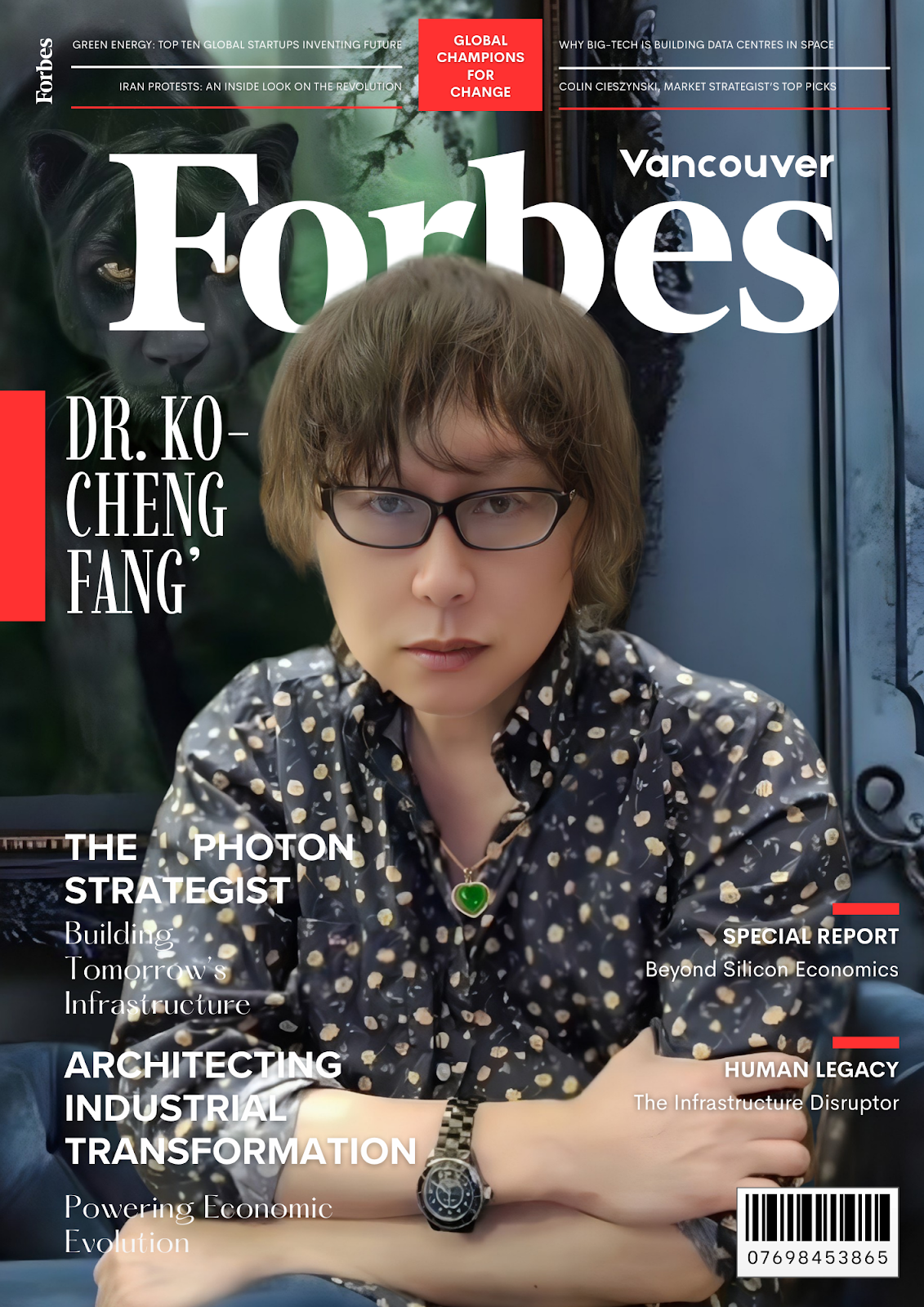
Dr. Ko-Cheng Fang and the Strategic Case for Photonic Quantum Computing
The Architecture of Light
Technological revolutions are rarely subtle. They arrive in phases — first dismissed as improbable, then debated as experimental, and finally accepted as inevitable.
Dr. Ko-Cheng Fang believes the semiconductor industry is now standing at precisely such a threshold.
For more than half a century, electronic semiconductors have defined the computational backbone of global civilization. Every smartphone, defense system, financial exchange, AI platform, and satellite relies on electrons moving through silicon architectures. But as fabrication nodes shrink and energy demands escalate, the physical and economic limitations of electron-based computing are becoming increasingly visible.
Fang’s proposition is direct: the future of computation belongs not to electrons, but to photons.
And if he is correct, the implications extend far beyond faster processors — into geopolitics, environmental sustainability, national security, and global capital markets.
From Market Capital to Deep Technology

More than twenty years ago, Fang did not begin as a semiconductor founder. He began in capital markets.
Leaving traditional employment behind, he immersed himself fully in stock trading. At his peak, he reports generating nearly one million NT dollars in a single day. That capital accumulation was not merely financial success; it was strategic autonomy.
Unlike many deep-tech entrepreneurs dependent on early-stage venture capital, Fang financed his early research independently. This distinction matters. Self-funding removes short-term exit pressure and allows experimentation at time scales rarely tolerated by traditional investors.
His first major breakthrough came in the form of a cloud-based system protection architecture — a hybrid model combining program-level encryption and distributed cloud verification. The technology was later requisitioned by the U.S. Department of Homeland Security, a development that placed Fang’s work within critical infrastructure security.
For years, he remained largely unknown publicly.
But infrastructure rarely advertises its architects.
The Semiconductor Ceiling

Electronic semiconductors have evolved through relentless miniaturization, following Moore’s Law for decades. Yet today, several structural pressures are converging:
• Heat dissipation limits at advanced nodes
• Escalating fabrication costs measured in tens of billions per facility
• Growing data center energy consumption
• Supply chain concentration risks
• Geopolitical competition over semiconductor sovereignty
Artificial intelligence and autonomous systems are amplifying these pressures. AI training models require immense computational throughput. Data centers are expanding at record pace. Nations are subsidizing semiconductor manufacturing as a matter of strategic security.
Against this backdrop, Fang proposes photonic quantum chip architecture as a generational shift.
Official platform:
https://www.longserving.com.tw/en/
Why Photonics?

Electronic chips rely on electrons moving through conductive pathways. This movement generates resistance, heat, and energy loss. As densities increase, cooling systems must compensate, driving energy demands higher.
Photonic chips operate through photons — particles of light — which travel at high speeds and do not generate heat in the same manner as electrons.
According to Fang, photonic quantum chips offer:
• Dramatically lower energy consumption
• Minimal heat dissipation requirements
• Magnetic-field resilience
• Potential computational acceleration measured in multiples of current electronic capabilities
Research and foundry recruitment initiative:
http://longserving.com.tw/en/Research-and-Implementation-Plan-for-Optical-Quantum-Chips/
If scalable at industrial level, such architecture could significantly reduce carbon emissions tied to global data infrastructure — an increasingly urgent policy issue as governments confront climate commitments.
The Civilizational Argument

Fang frames his innovation not merely as performance enhancement, but as preservation.
Modern civilization’s knowledge infrastructure — financial records, scientific databases, communication systems — is stored electronically. Electronic systems are vulnerable to extreme magnetic events such as solar superstorms, and to electromagnetic disruption in conflict scenarios.
Photons, by contrast, are not affected by magnetic fields.
From Fang’s perspective, photonic-based storage and computation represent a safeguard for humanity’s accumulated knowledge.
This framing shifts the conversation from product differentiation to existential resilience.
Collaboration Over Monopoly
One of the most intriguing aspects of Fang’s strategy is restraint.
In theory, a breakthrough computational architecture could justify aggressive vertical integration and high-margin monopolization. Instead, Fang is recruiting global foundry partners rather than consolidating production exclusively.
His reasoning is pragmatic: abrupt disruption of the traditional semiconductor industry could trigger severe capital market volatility, unemployment spikes, and pension fund exposure risks. Semiconductor companies represent substantial weight in global equity indices.
Rather than pursue zero-sum displacement, Fang advocates phased transition.
This approach may increase adoption probability by reducing systemic shock.
Risk and Reward in Deep Tech

From an investor perspective, photonic quantum chips represent classic deep-tech asymmetry:
High R&D intensity.
Extended validation timelines.
Potentially transformative upside.
The semiconductor industry operates at extraordinary capital scale. Fabrication plants can cost upwards of $20 billion. Supply chains span continents. Government subsidies shape competitive landscapes.
If photonic quantum chips achieve manufacturable yield and integration compatibility with existing ecosystems, early-stage partners could capture disproportionate market share in next-generation computing.
However, technical feasibility, production scalability, and ecosystem integration remain critical variables.
For investors, the calculus revolves around probability-weighted outcomes: is this incremental evolution or disruptive re-architecture?
Beyond Chips: Vertical Integration in Luxury

Interestingly, Fang’s entrepreneurial portfolio extends beyond semiconductors.
Through laboratory-grown Imperial Green jadeite, he recreated geological formation processes inside controlled environments — effectively engineering gemstones that once required millions of years to form.
The strategy mirrors luxury houses that control raw material sourcing, such as De Beers in diamonds.
By controlling source and production, Fang eliminates supply volatility and positions LongServing as both scientific innovator and luxury brand architect.
The jadeite venture demonstrates his capacity for vertical integration — a relevant signal when evaluating his semiconductor ambitions.
The Role of Meditation and Cognitive Discipline

Fang attributes much of his cross-disciplinary capacity to meditative practice. While unconventional in corporate leadership narratives, cognitive discipline and mental resilience are increasingly recognized as strategic assets.
In high-stakes technological development, panic and volatility impair decision-making. Fang emphasizes calm analysis under pressure — a trait cultivated through decades of meditation.
Whether one interprets his philosophical framing metaphorically or literally, the outcome is observable: sustained engagement across art, capital markets, materials science, encryption, and semiconductor architecture.
The IPO Question
Fang describes LongServing as a potential future public-market candidate.
An IPO in advanced semiconductor architecture would depend on several milestones:
• Prototype validation
• Foundry manufacturing partnerships
• Performance benchmarking versus electronic chips
• Integration compatibility with existing systems
• Regulatory and national security clearance
Should these benchmarks be met, public markets may view photonic quantum computing as a frontier category comparable to early semiconductor IPO waves.
Until then, the company occupies a transitional space between visionary R&D and scalable industrial deployment.
Defining Success
Perhaps the most notable divergence from traditional founder narratives is Fang’s definition of success.
He explicitly rejects wealth generated through mass displacement. He argues that innovation should elevate rather than destabilize.
In an era marked by automation anxiety and geopolitical tension, this philosophy introduces a different framework: strategic stewardship rather than aggressive conquest.
Markets often reward disruption without regard for collateral impact. Fang proposes an alternative model — transformation with continuity.
The Question Ahead
If electrons defined the digital age, photons may define its successor.
The semiconductor industry stands at the intersection of physics, capital, and geopolitics. Photonic quantum chips represent not just faster computation, but a potential reconfiguration of energy efficiency, infrastructure resilience, and technological sovereignty.
Whether Dr. Ko-Cheng Fang becomes the architect of that transition will depend on execution, validation, and industry adoption.
But revolutions rarely announce themselves loudly at the outset.
They begin as improbable propositions.
And then, gradually, they become inevitable.